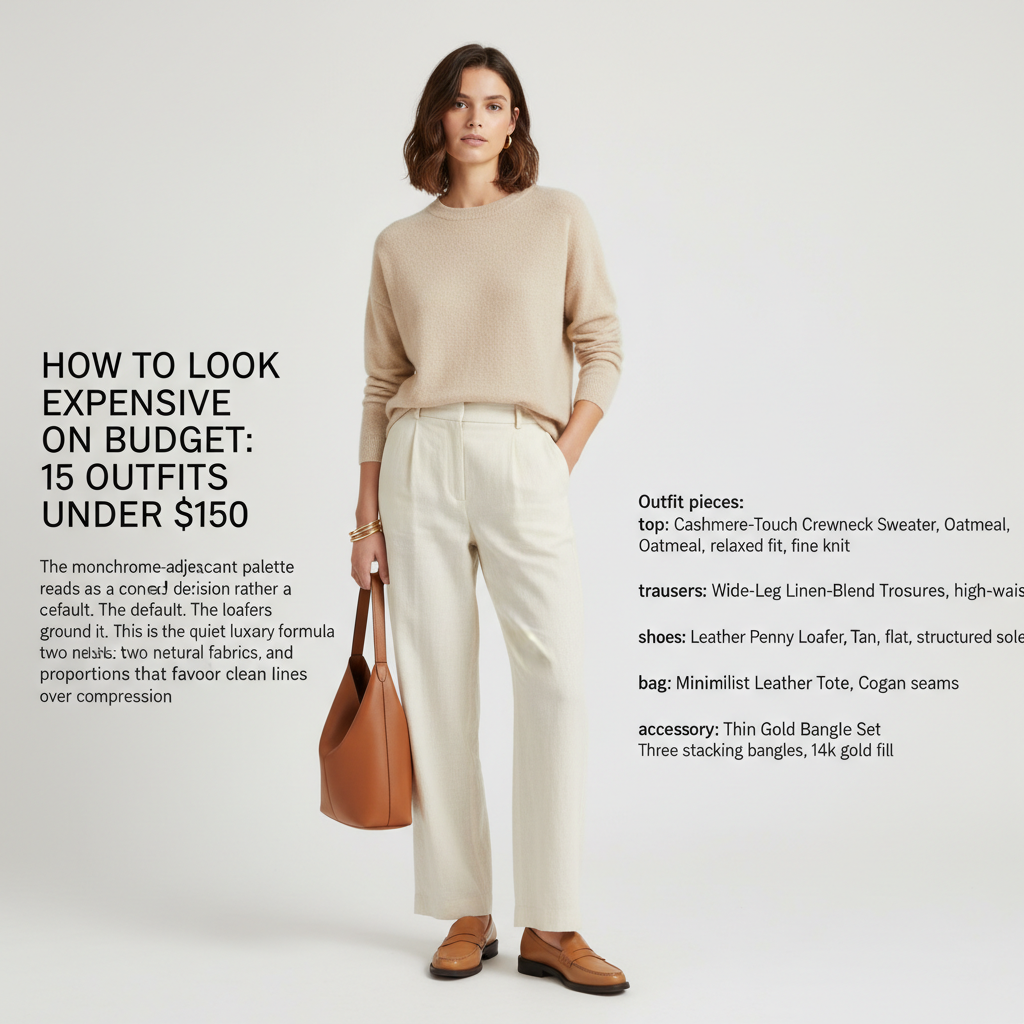
There is a specific aesthetic that has taken over the internet in the last two years — an aesthetic defined not by logos or trends, but by their deliberate absence. Quiet luxury. Old money. Stealth wealth. Whatever you call it, the visual language is consistent: neutral tones, natural fabrics, clean lines, impeccable fit, and a studied indifference to being recognised as fashion-forward. The Row, Toteme, Loro Piana. The look costs a fortune in its original form. But the underlying logic — which is really just a set of principles about what makes clothing read as expensive — costs nothing to understand and far less than you'd think to execute.
The key insight is this: expensive-looking clothing is not primarily about price. It's about three things: fabric behaviour, fit, and the absence of cheap signals. Cheap signals include: visible synthetic sheen, poor seaming, too-bright colours, obvious branding, pills and pulls after washing, and — above all — clothes that don't fit correctly. None of these things require a luxury budget to avoid.
What follows is the formula, the principles, and fifteen outfits that prove it — each under $150, all built from brands that have learned to make fabric behave like it costs more than it does: Mango, ARKET, COS, Uniqlo, & Other Stories. The goal isn't to look like you shop somewhere expensive. It's to look like someone who doesn't need to prove anything — which is, of course, the most expensive signal of all.
Fabric First: Where Cheap Always Shows
The single most reliable indicator of an inexpensive garment is how its fabric behaves. Cheap polyester catches light in a way that reveals its synthetic structure — a slight sheen that reads as plasticky, not polished. It also resists draping: it holds its factory shape rather than moving with the body. Natural fabrics — cotton, linen, wool, silk — absorb and diffuse light rather than reflecting it, which is why they photograph and appear differently even to the naked eye. The good news: brands like Uniqlo, COS, ARKET, and Mango have invested heavily in natural-blend fabrics that behave like the real thing at a fraction of the price. Check the fabric composition label. If it's more than 40% polyester in a garment you're wearing as a statement piece, consider whether there's a better option at a similar price.
Fit Is the Multiplier: Why $50 Can Look Better Than $500
A perfectly fitting $50 blouse will always read as more expensive than a poorly-fitting $500 one. Fit is the multiplier that either amplifies or negates every other signal in your outfit. The places fit matters most, in order: the shoulder seam (it should sit at the exact edge of your shoulder — too wide is the most reliable signal of cheap ready-to-wear), the waist (clothes that skim the body's natural shape read as tailored; clothes that hang away from it read as ill-fitting), and the trouser break (the hem should graze the top of your shoe, not pool on the floor or show your ankle bone unless deliberately cropped). A tailor can correct the shoulder seam and hem for under $30, which is the single highest-ROI alteration in fashion.
The Quiet Luxury Colour Palette
The quiet luxury colour palette is not an accident — it's a deliberate signal set. Neutral tones (oatmeal, camel, cream, sand, taupe, ivory, ecru) dominate because they exist in nature and read as unconstructed rather than designed. They also photograph beautifully across all lighting conditions. The palette allows expensive fabrics to speak without colour competing for attention. The operative principle: if your colour is doing the visual work, your fabric doesn't have to — which is fine for a trend piece but counterproductive for a quiet luxury look. The accent colours that work within the quiet luxury framework: forest green, burgundy, navy, and warm white. These are all tones that exist in the natural world and read as considered rather than reactive.
The Signals to Eliminate First
Before adding expensive elements, eliminate the signals that read as cheap. Visible logos (unless it's a heritage brand used with irony, which requires significant confidence to pull off). Fast-fashion fabrics that pill after two washes — these are identifiable at close range and signal that the garment wasn't expected to last. Clothes that are too tight in ways that create visible strain lines — quiet luxury clothing sits away from the body with ease rather than clinging. Colours that are too bright or too saturated — neon and candy-bright tones have no place in quiet luxury because they require attention rather than rewarding it. And the most overlooked: worn-out shoes. You can wear a $30 top and a $800 pair of loafers and look expensive. The reverse — a $500 blouse with visibly worn-out shoes — does not work.
What are the best affordable brands for quiet luxury style?
The brands that have most consistently produced quiet luxury pieces at accessible prices: Uniqlo (for basics — cashmere-touch knitwear, wide-leg trousers, silk blouses), Mango (for structured pieces with genuine tailoring — blazers, trousers, midi skirts), ARKET (for natural fabrics and considered basics), COS (for architectural, minimalist pieces that sit between fashion and design), and & Other Stories (for accessories and shoes with an editorial edge). These five brands collectively cover everything you need for a quiet luxury wardrobe at an accessible price point.
Is quiet luxury just neutrals and minimalism?
Quiet luxury is defined by restraint and quality signals, not by a specific colour palette — though neutrals dominate because they naturally communicate those qualities. You can wear forest green, burgundy, or navy in a quiet luxury register without breaking any rules. The key markers are: fabric quality (natural fibres, good drape), absence of obvious logos, deliberate fit, and an overall sense that the outfit was assembled with consideration rather than purchased as a trend. A tailored burgundy blazer in wool is quintessentially quiet luxury. A burgundy blazer with a brand logo in polyester is not.
Can I look expensive in fast fashion?
Selectively, yes. The principle: buy fast fashion for pieces where fabric quality is less visible (accessories, layering pieces, basics worn under structured items) and avoid it for pieces where fabric behaviour is the entire point (blouses, trousers, knitwear worn as standalone pieces). A Zara structured blazer in a good season can genuinely look expensive — their tailoring has improved significantly. A Shein silk-touch blouse generally cannot, because the fabric's behaviour under light reveals its composition immediately. The test: does it look different in person than in the product photo? If the answer is yes, the fabric is not behaving well.
What's the most important piece to invest in for a quiet luxury wardrobe?
A well-fitting blazer is the single highest-leverage investment in a quiet luxury wardrobe. It instantly elevates everything worn under it, it photographs beautifully, it works across seasons, and a good one will last a decade. The second-highest leverage investment is shoes — specifically a pair of quality loafers in a neutral leather. Shoes are visible at close range and degrade in obvious ways; cheap shoes undermine the rest of an outfit more reliably than any other garment. After blazer and shoes, invest in trousers (which pill and lose their shape quickly in poor fabrics) before blouses and accessories.
How do I shop for quiet luxury pieces at Zara/Mango/H&M?
Apply the fabric filter first: check the composition tag and avoid anything that's primarily polyester in a garment you'll wear as a standalone piece. Then apply the construction filter: check the seams (they should be straight and finished cleanly, not fraying), the lining if present (a blazer with no lining or a cheap acetate lining is revealing of its price point), and the buttons (cheap buttons are lightweight and wobble — better pieces have weighted, firmly-attached buttons). Finally, apply the fit filter: does it sit correctly on the shoulder? Does the waist fall at the right point? If all three pass, the price of the label is almost irrelevant to how the garment will read when worn.
What is the difference between quiet luxury and minimalism?
Minimalism is an aesthetic defined by reduction — fewer items, simpler shapes, less colour. Quiet luxury is defined by quality signals and the absence of status display — it's possible to wear maximalist jewellery, interesting textures, or layered prints in a quiet luxury register, as long as the underlying quality is evident and the branding is absent. The two aesthetics overlap significantly (both favour neutral tones, clean lines, and natural fabrics) but are not identical: a quiet luxury outfit can be layered and complex; a minimalist outfit can be inexpensive and quiet. The simplest distinction: minimalism is about editing; quiet luxury is about signalling without shouting.