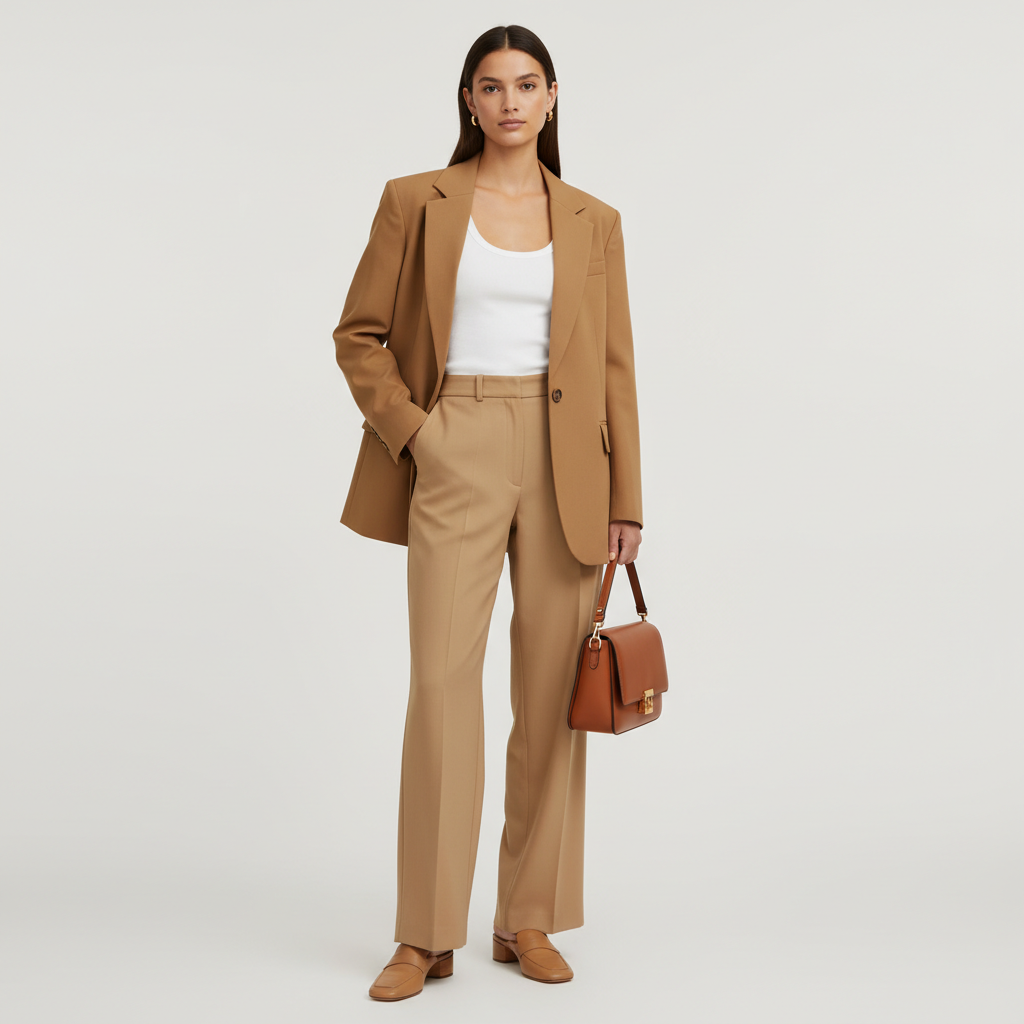
"Business casual" is one of the most searched dress codes on the internet — and also one of the most genuinely confusing. A 2023 LinkedIn Workforce Report found that 58% of office workers report feeling uncertain about their company's dress code expectations, with women reporting higher levels of uncertainty than men. This isn't surprising: men's business casual has a relatively stable template (chinos + button-down). Women's version spans an enormous range, from tailored blazer sets to smart knitwear to elevated denim — with no consensus on where the line sits.
The short answer to "what is business casual for women in 2026" is this: it's an outfit that reads as intentional and polished without requiring a matching suit. It means no activewear, no graphic tees, no flip-flops, and no jeans that look like they came from a weekend hike. Within those parameters, you have enormous latitude.
The longer answer — the one that actually helps you get dressed on Monday morning — is a formula: one structured piece (blazer, tailored trouser, or ponte dress) plus one elevated basic (silk blouse, fine-knit sweater, or quality tee) plus one intentional shoe (loafer, block heel, or clean trainer in a creative environment). Everything else follows from there. This guide gives you the theory, then gets practical fast.
The Business Casual Formula (It's Simpler Than You Think)
Stop trying to define the dress code in abstract terms. Instead, use this formula: one structured piece + one elevated basic + one intentional shoe = business casual. Structured pieces include blazers, tailored trousers, ponte dresses, and midi skirts with a clear shape. Elevated basics include silk blouses, fine-knit sweaters, quality tees in neutral tones, and fitted tanks. Intentional shoes mean anything with structure and quality — loafers, block heels, clean leather trainers, pointed flats. Combine any one from each category and you've cleared the bar. The rest is style.
What's Changed: Business Casual in 2026 vs 2020
The post-pandemic return to office brought a fundamental shift in what 'professional' means. The stiff pencil skirt and matching blazer set has largely been replaced by outfits that prioritise comfort without sacrificing intention — wide-leg trousers over slim cuts, loafers over pointed heels, quality knitwear over polyester blouses. Quiet luxury aesthetics (think The Row, Toteme, Cos) have set the visual benchmark even for non-luxury budgets: clean lines, natural fabrics, minimal branding. The new business casual is less about dressing for authority and more about dressing with confidence.
Building a 5-Piece Business Casual Capsule Under $400
You need fewer pieces than you think. A five-piece capsule that generates 15+ business casual outfits: 1) A tailored blazer in a neutral (navy, camel, or black) — the anchor piece. 2) Wide-leg trousers in a second neutral that works with the blazer. 3) Two elevated tops — one crisp (silk-touch blouse or button-down) and one relaxed (fine-knit or ribbed tank). 4) A ponte or crepe midi dress that works with or without the blazer. 5) One pair of quality loafers or block-heel shoes. These five items create a matrix of combinations that will cover every business casual occasion for an entire season.
Desk to Dinner: How to Transition Without Changing
The best business casual outfits are ones that earn their keep twice. To move a work outfit into evening without changing: swap the structured tote for a smaller clutch or crossbody, add a more statement earring in place of studs, undo the top button of a blouse or let the blazer fall open, and if you wore flat loafers all day, slip into a block heel you kept in your desk drawer. The key transition items to always keep at the office: a silk scarf, a pair of small gold hoops, and a compact evening bag. These three items can elevate any business casual outfit into something that belongs at a 8pm dinner reservation.
Are jeans business casual for women?
Dark-wash, unripped, well-fitting jeans can qualify as business casual in many modern workplaces — particularly tech, startups, creative agencies, and media companies. The rule of thumb: if the jeans could pass for trousers at a quick glance, they're in. This means no visible distressing, no light wash, no overly casual cuts (baggy, low-rise). Paired with a blazer and loafers, a quality dark jean is a legitimate business casual choice in 2026. In more traditional industries — finance, law, consulting — the bar is still trousers.
Can I wear a dress to a business casual office?
Absolutely — a dress is often the easiest business casual outfit to build, because the structure is already built in. Midi-length dresses in ponte, crepe, or silk-touch fabrics are ideal. Shirt dresses and wrap dresses work universally. Mini dresses need more context — they can work in creative environments with tights and ankle boots, but read as casual in traditional offices. The key is fabric and structure: a well-cut midi dress in a quality fabric will always outperform a cheap blazer-and-trousers combination.
Are trainers business casual?
In 2026, clean leather trainers or minimalist white sneakers (think Common Projects, Veja, New Balance 550) are business casual-appropriate in creative and tech environments. The critical qualifier is 'clean' — trainers that look like they've been to the gym are not business casual. In traditional industries, the answer is still no. A useful test: if your trainer could plausibly be displayed in a museum of design alongside the office furniture, it's probably business casual. If it has neon detailing and a visible air pocket, it isn't.
What fabrics work best for business casual?
Natural and structured fabrics signal quality and intention regardless of price point: cotton, linen, silk, wool, and ponte. Avoid anything that looks plasticky, pills easily, or shows sweat (synthetic fabrics in fitted cuts are the main culprit). The practical shortlist: ponte and crepe for trousers and dresses (they hold their shape and resist creasing), cotton-modal blends for blouses and tanks, and a blazer in any fabric with a clear structure at the shoulder. The test: does it look intentional after an eight-hour day? If yes, it's business casual fabric.
Is business casual the same everywhere in the world?
No — and the differences matter if you're dressing for an international context. American business casual is the most relaxed: dark jeans often qualify, and brands matter less than fit. British business casual leans more formal: a blazer is almost always expected, and the palette skews darker. French professional dressing values individual style over conformity — an interesting textile or an unusual colour is a feature, not a bug. Asian business environments (particularly finance hubs like Tokyo and Singapore) typically run more formal than their Western equivalents: tailored trousers over jeans, and closed-toe shoes as a baseline.
How do I dress business casual on a tight budget?
Prioritise structure over brand. A £40 blazer from Mango with a clean shoulder and decent lining will outperform a £200 blazer with poor construction every time. The pieces worth investing in: trousers (cheap ones pill and lose their shape quickly) and shoes (quality construction is visible at close range). The pieces where affordable options work just as well: blouses and tanks (silk-touch polyester is genuinely good now), accessories, and dresses in ponte fabric. Zara, Mango, ARKET, and COS all produce business casual pieces that photograph and wear well at prices that don't require a career to justify.